
Home › Coverages › Workers' Comp Insurance for Dental Offices
Workers' comp for dental teams
Workers' comp for a dental office pays medical care and part of lost wages when a hygienist, assistant or front-desk team member is hurt or made ill by the job, from a contaminated sharp to a back that gives out after years at the chair. Most states require it once you hire, and the price is driven mostly by your payroll and the class code your office is rated under.
- Since 2003
- 12+ A-rated carriers
- 28 states
- Independent agents
Start your dental practice insurance quote
Takes about two minutes. A licensed agent follows up.
Licensed in 28 states · NPN 7642818 · Since 2003
What workers' comp for a dental office pays for
Workers' compensation insurance pays benefits set by state law when an employee is injured or becomes ill because of work. For a dental team, that usually means medical treatment, part of the wages lost while someone recovers, and therapy or rehab to get them back to the chair.
A standard comp policy has two parts. Part One pays the state's comp benefits. Part Two is employer's liability, which can respond when an employee's injury leads to a lawsuit against the practice that falls outside the comp system.
The policy follows your payroll. Hygienists, dental assistants, sterilization staff, the front desk, the office manager and any associate dentist you employ are typically all on it. Owner-dentists are different: depending on the state and how the practice is organized, an owner may be included automatically, excluded unless they elect in, or allowed to opt out. Your state page and your carrier settle that question.
The class code behind your rate
Comp is priced by class code, and dental offices land in one of the lower-rated classes. In NCCI states, a dental office is commonly rated under the physician-and-clerical class, Code 8832, but your carrier confirms the code. The class takes in the front office too, so receptionists and billing staff aren't normally split out at a different rate.
Some states use independent rating bureaus that number their classes differently. California rates dental practices under its own class, 8839. Pennsylvania uses 0957, "Physician or Dentist, All Employees Including Office." Dental labs are a separate class: 4692 in NCCI states, and 0489 in Pennsylvania. The final code is the carrier's and the bureau's call.
Where OSHA fits
OSHA sets the safety rules; comp pays for the injuries that happen anyway. The federal Bloodborne Pathogens Standard covers anyone on your team with occupational exposure to blood or saliva. It calls for a written exposure control plan reviewed at least yearly, the hepatitis B vaccine made available at no cost, and medical follow-up after an exposure. Offices of dentists are partially exempt from keeping the OSHA 300 injury log, but serious injuries must still be reported. Our guide to dental office OSHA rules covers this in depth, and the full standard is on OSHA's bloodborne pathogens page.
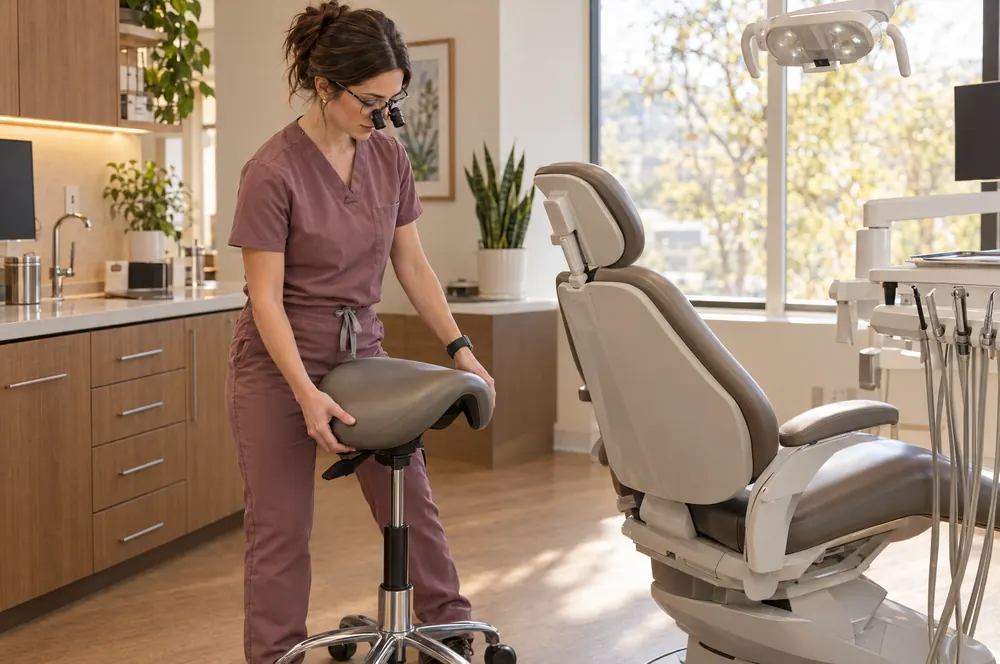
What dental workers' comp usually covers, and what it doesn't
| What it usually covers | What it usually doesn't |
|---|---|
| Doctor visits, surgery and prescriptions for an injury caused by the job | Injuries to patients or visitors (malpractice or general liability) |
| Post-exposure visits and testing after a sharps or splash incident, as your state allows | Owners who are excluded or haven't elected coverage |
| Part of the wages lost while a team member can't work | Contractors with their own comp, if you keep their certificates |
| Physical therapy and rehab for strain injuries | Wrongful termination or harassment claims (that's employment practices liability) |
| Benefits for repetitive-strain claims your state accepts | Unpaid overtime or wage disputes |
| Employer's liability for some injury lawsuits (Part Two) | Injuries that have nothing to do with work |
Benefits, waiting periods and what counts as a work injury are set by each state, so check your state's comp agency for the details.
Three dental comp claims, three different shapes
These examples are fiction. They show how differently a comp claim can run in a dental office.
Example scenario: a scalpel blade on a surgical tray
At an oral surgery practice, an assistant breaking down a tray on a Thursday afternoon catches her finger on a used blade. She reports it right away. The post-exposure evaluation, the lab work and the follow-up visits over the next few months are filed as a comp medical claim. She never misses a shift, so there's no wage loss, but the claim still appears on the practice's loss history.
Example scenario: water by the autoclave
On a Tuesday at a pediatric practice, a sterilization assistant slips on water that pooled near the autoclave and breaks her wrist. She's off for six weeks, then back on light duty. Comp may pay her surgery, therapy and part of her wages. It won't pay for the temp the office brings in to keep instruments moving.
Example scenario: an associate's neck after six years
An associate at a four-dentist group tells the practice administrator on a Monday that the numbness in his hand is getting worse. A specialist links it to his neck and to years of leaning over patients. Because he's an employee of the group, the claim runs through the group's comp policy. One of the partners with the same symptoms might not be covered, if the partners excluded themselves.
The comp gap dentists miss most often
What sets the price of dental office comp
Comp premium starts with arithmetic: payroll in each class, divided by 100, times that class's rate. Next, your experience modification adjusts that figure, rising or falling with how your claims history compares with what's expected for an employer like you. You pay a deposit up front from your payroll estimate, and the audit after the policy year settles it against what you actually paid your team.
| Indiana class, advisory rates effective January 1, 2026 | Rate per $100 of payroll | Indiana minimum premium |
|---|---|---|
| 8832 Physician & Clerical (dental offices) | $0.174 | $215 |
| 4692 Dental Laboratory | $0.339 | $267 |
Using Indiana's January 1, 2026 advisory rate, an office with $500,000 of payroll would start near $870 before its experience mod, carrier pricing and minimums. Indiana has already approved its January 1, 2027 advisory rates, and Code 8832 stays at $0.174. Rates differ by state, by carrier and by year, so treat that as one state's illustration, not a quote.
Payroll changes are what usually move the bill. Hiring a second hygienist, adding a Saturday schedule or opening another office all raise payroll. Tell your carrier mid-year so the audit doesn't bring a surprise. What the rest of your program costs depends on your building and equipment values, your revenue and payroll, how many locations and team members you have, the limits you choose and your claims history.
Who needs to look hardest at comp
- Owners making their first hire. In many states the first assistant or hygienist triggers the requirement. Our start-up insurance guide puts comp on the opening calendar.
- Growing groups. More dentists means more payroll, more chairside hours and more questions about which partners are on the policy. Group practice insurance
- Multi-location groups. Offices in two states mean two sets of comp rules, and one of those states may require the state fund. Insurance for dental groups and DSOs
- Dental labs. Technicians are rated under a separate manufacturing-type class, with grinding, milling and furnace work in the mix. Dental lab insurance
State rules that change the comp picture
Comp is a state program, and the rules shift noticeably at the state line.
- Ohio sells comp only through the Bureau of Workers' Compensation, the state fund. BWC benefits don't include employer's liability, so many practices add stop-gap employer's liability from a private carrier, often on the GL or business owner's policy. Ohio dental practice insurance
- Texas lets most private employers choose. A practice that goes without comp is a "non-subscriber," must file notice with the state, and gives up key defenses if an injured employee sues. Texas dental practice insurance
- North Carolina generally brings an employer under its comp law when three or more employees regularly work for it in the state. If your office is close to that line, confirm with the North Carolina Industrial Commission. North Carolina dental practice insurance
- New Jersey requires a corporation to carry comp if anyone performs services for it, officers included. That can mean a dental PC where only the owner works still needs a policy. New Jersey dental practice insurance
- Florida requires comp for a dental office at four or more employees, and corporate officers count toward four unless they file an exemption. Florida dental practice insurance
Related coverage
Workers' comp questions from dental offices
Do I need workers' comp for a small dental office?
How much does workers' comp cost for a dental office?
Does workers' comp cover the owner-dentist?
Are per-diem or temp hygienists covered by my comp policy?
Can an Ohio dental practice buy workers' comp from a private insurer?
Ready to see what you'd pay?
Independent agents, 12+ A-rated carriers, and a licensed agent back to you within one business day.